No response.
I stepped into the hallway and found Amanda standing barefoot at the top of the stairs. Her arms were wrapped around herself.
“Mama Margaret,” she whispered, “Daddy’s truck is gone.”
I told her he had probably gone out to buy something.
She stared at me with those serious eyes.
Even at fifteen, she knew when someone was trying to protect her from the truth.
I called Robert’s workplace.
He was not there.
I called his brother, his closest friend, his foreman, and every other person I could think of.
No one had seen him.
His phone was switched off.
After an hour of unanswered calls, fear took hold of me. I was preparing to contact the police when I noticed a folded piece of paper on the kitchen table.
The sugar bowl had been placed on top of it.
My hands shook as I unfolded the note.
It contained only one sentence.
“I’m sorry, but I can’t do this anymore.”
That was all.
No explanation.
No farewell.
No mention of the children.
Nothing about our wedding.
Nothing about the life we had been building.
I read the sentence repeatedly, waiting for the words to form some kinder meaning.
They never did.
I had barely managed to sit down when Sophie entered the kitchen in her pajamas.
She wrapped her small arms around my leg and looked up at me with Robert’s eyes.
“Mama, can I have some juice?”
In that moment, my heart broke in two different directions.
One part broke for the man who had left me.
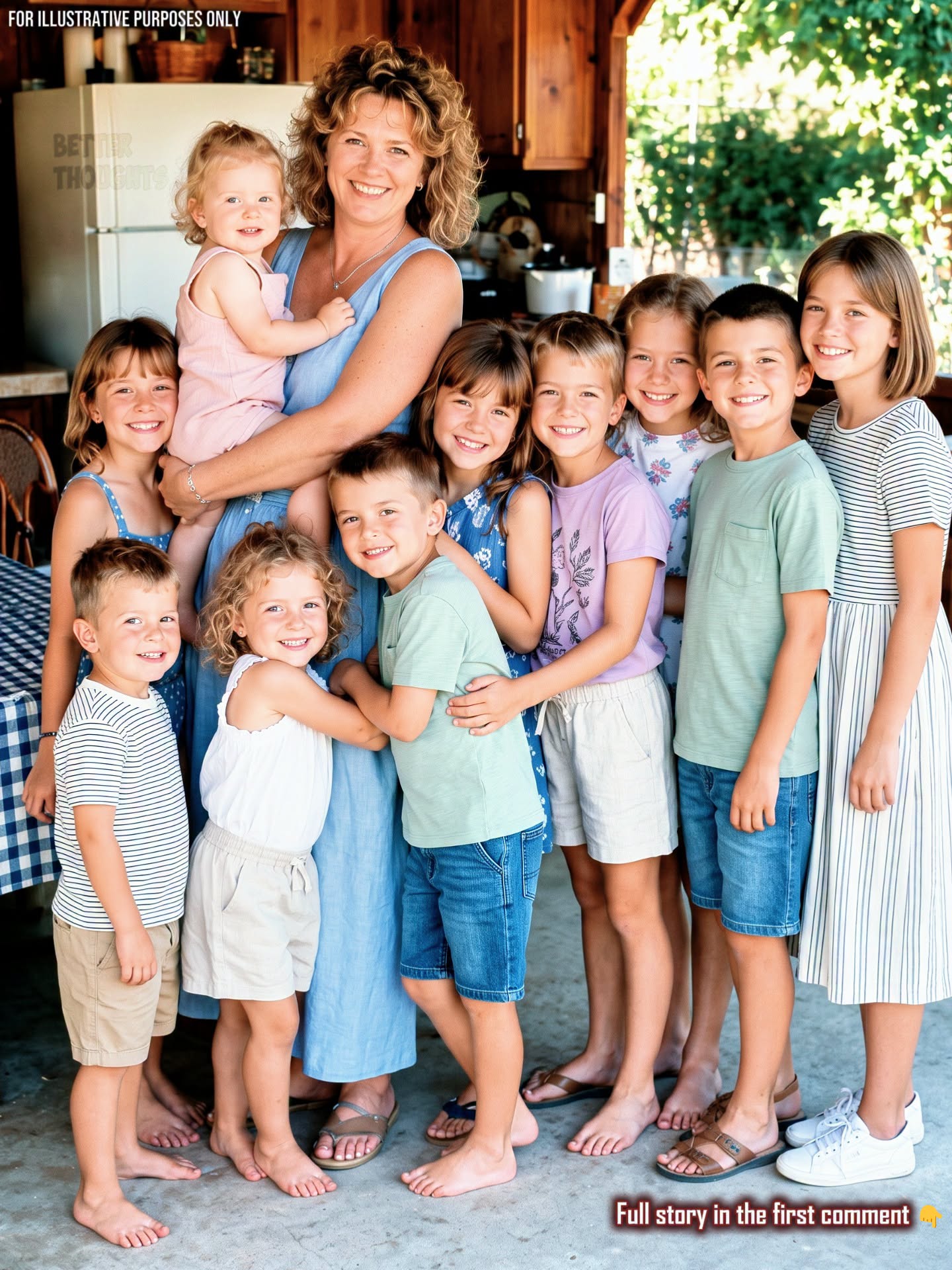
The other broke for the ten children he had left behind.
Everyone Told Me to Walk Away
My mother called shortly afterward.
When I told her what had happened, she became quiet.
Then she said the words I had feared she would say.
“Margaret, this is your chance to leave.”
“They’re upstairs, Mama.”
“They are not your children.”
“They need me.”
“They need proper placement. The authorities will find homes for them.”
“Separate homes?” I asked. “Different families?”
“You cannot raise ten children alone.”
“I can’t abandon them.”
“You are thirty-two years old. You still have time to build your own life.”
I looked toward the staircase.
Sophie sat on the bottom step, holding her cup. Amanda stood behind her, listening. The others were crowded nearby, pretending they were not afraid.
“My life is already here,” I said.
My mother’s voice hardened.
“Don’t be foolish, Margaret.”
“I’m not leaving them.”
She ended the call.
Over the next several days, relatives and family friends contacted me. Even members of Robert’s family suggested that the children should enter foster care.
They said I was too young to sacrifice my future.
They said ten children were too much for one woman.
They said someone else would take responsibility.
But every night, those children gathered around my table.
Every morning, they looked toward me for reassurance.
They had already lost their mother.
Now their father had disappeared.
I could not become another person who walked away.
The Signature That Made Me Their Mother
At the county office, a social worker with kind eyes placed a stack of documents in front of me.
“Emergency guardianship is only the beginning,” she explained. “Permanent adoption could take years.”
“I understand.”
“Ten children are an enormous responsibility.”
“I understand that too.”
“There is no shame in deciding you cannot do this.”
I thought of Amanda trying not to cry in front of the younger children.
I thought of Derrick repairing things because fixing objects was easier than speaking about his feelings.
I thought of Sophie calling me Mama.
“They already believe I’m their mother,” I said. “I cannot teach them that mothers leave.”
The social worker studied me for a long moment.
Then she pushed the papers closer.
My signature came out crooked because my hand would not stop trembling.
The legal process took years.
But in my heart, they became my children the moment I signed that first page.
The Year That Nearly Broke Me
Love did not make the next year easy.
There were bills I could barely pay, illnesses that spread from one child to another, school meetings, broken appliances, and nights when I wondered how we would make it to the end of the month.
I worked during the day at a fabric warehouse.
At night, after the younger children were asleep, I sewed uniforms for a local school district.
Amanda learned how to prepare simple dinners.
Derrick took responsibility for the yard and anything mechanical.
Sue organized the laundry.
Jacob and David were assigned the dishes, although they spent more time splashing each other than washing plates.
The quadruplets handled smaller chores under heavy supervision.
Even little Sophie carried napkins to the table with both hands and smiled as though she had performed a miracle.
We became a team because we had no other choice.
Still, there were nights when the house finally became quiet and I sat alone at the kitchen table.
Those were the hours when Robert’s absence felt unbearable.
I asked myself the same questions again and again.
Had he met someone else?