Yes.
When children are walking through areas where ticks are present, clothing that covers more of the skin can reduce opportunities for ticks to reach exposed skin.
Depending on the conditions, this can include:
Long pants
Socks
Closed-toe shoes
Long sleeves
Certain tick repellents or treated clothing may also be appropriate in some circumstances.
When using repellents on children, always follow the product’s instructions and age restrictions carefully.
What About Dogs and Cats?
Pets can also carry ticks.
Dogs and cats that spend time outdoors may bring ticks into the home.
Ask your veterinarian about appropriate tick prevention for your pet.
Checking pets after outdoor activities can also help reduce the chance of ticks entering the household.
What Should You Never Do When Removing a Tick?
When you discover a tick on your child, avoid improvised methods.
Don’t burn the tick.
Never use a match, lighter, or other source of heat.
Don’t cover it with oil or Vaseline.
This is not the recommended method of removal.
Don’t crush the tick.
This can make removal more difficult.
Don’t dig into the skin.
Trying to remove tiny remaining pieces by cutting or digging into the skin can cause unnecessary injury.
Don’t give medication without medical advice.
A tick bite does not automatically require antibiotics or other medication.
Does a Large Tick Mean the Situation Is More Dangerous?
Not necessarily.
Ticks can vary considerably in size depending on their species, developmental stage, and whether they have fed.
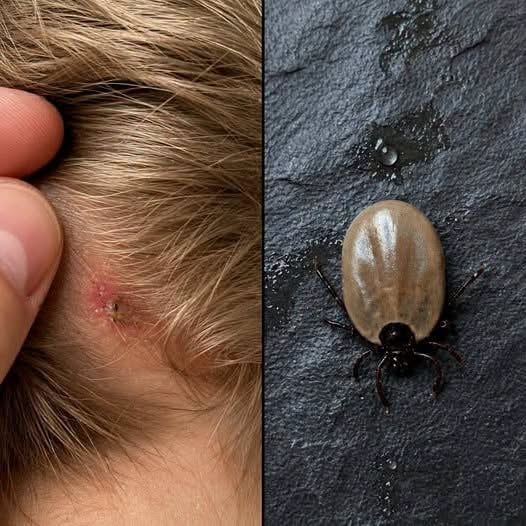
A tick that appears swollen may have been attached for some time, but its appearance alone cannot tell you whether an infection was transmitted.
Other factors are more important, including the local risk of tick-borne disease, the type of tick, the likely duration of attachment, and whether symptoms develop.
Does a Tick Bite Mean My Child Has Lyme Disease?
No.
This is one of the most important things for parents to understand.
A tick bite does not equal Lyme disease.
For Lyme disease to develop, an infected tick must transmit the bacteria responsible for the infection.
Many tick bites do not result in Lyme disease or another tick-borne infection.
Nevertheless, because some ticks can transmit infections, it is sensible to take the bite seriously and monitor your child.
The Best Response: Quick, Calm, and Careful
When you discover a tick on your child’s scalp, remember these basic steps:
1. Remove the tick correctly.
2. Clean the bite area.
3. Record the date and circumstances.
4. Monitor your child and the bite area.
5. Contact a healthcare professional if symptoms develop or you are concerned.
This is much more useful than panicking or trying several home remedies.
Final Thoughts
Finding a tick attached to your child’s scalp can be alarming, particularly when it is hidden among the hair or appears swollen. But a tick bite does not automatically mean that your child will become sick.
The most important thing is to remove the tick promptly and correctly using fine-tipped tweezers, then clean the area and monitor your child.
Avoid methods such as oil, Vaseline, heat, or chemicals. If you’re unable to remove the tick properly or you’re unsure about what you’ve found, contact a healthcare professional.
Over the following days and weeks, watch for symptoms such as an expanding rash, fever, unusual fatigue, or other changes in your child’s health.
And remember prevention: after outdoor activities, check the entire body—including the scalp, hairline, neck, and behind the ears.
With the right precautions and a calm response, finding a tick doesn’t have to become a frightening experience.