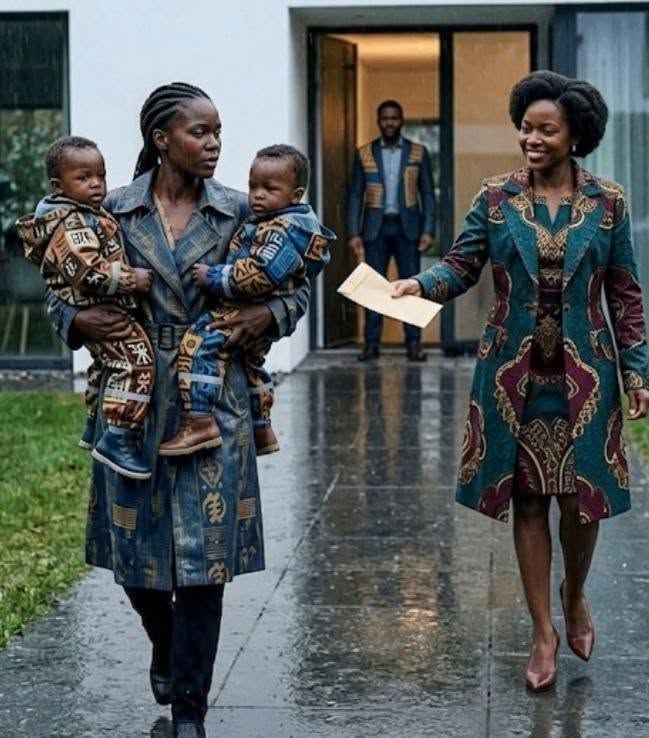
Kelechi tugged his mother’s sleeve. “Mummy, can we stay now?”
Adaeze sank to her knees. She pulled her children into her arms and wept.
Not tears of sadness.
Tears of something she hadn’t felt in years.
Hope.
When she looked up, Amara was walking toward the door.
“Wait,” Adaeze called.
Amara paused.
“Why are you doing this? You don’t even know me.”
Amara turned. For the first time, a small, sad smile appeared on her face.
“Because three days ago, I watched a good woman get thrown into the rain with her children. And I saw who I was becoming. I didn’t want to be that person anymore. This surprise… it’s not just for you. It’s for me too. It’s the only good thing I’ve done in a very long time.”
She stepped outside into the damp Lagos air.
Then she was gone.
Adaeze sat on the bare floor of her living room—her living room now—and held her children close.
The rain had stopped.
And for the first time in three days, the house felt warm.
The husband flung his wife and children out, but his lover followed them, gave the wife 10 million naira, and whispered in her ear, “Come back in three days… there will be a surprise for you…”
Espiode 3.
The first night in the empty house was strange.
No furniture. No curtains. No sounds of a television or the hum of a ceiling fan. Just the soft breathing of Kelechi and Chiamaka, curled up on a foam mattress that a kind neighbor, Mama Bose, had lent them.
Adaeze lay awake, staring at the cracks in the ceiling.
She kept touching the keys in her pocket. Her keys.
The house was hers.
But what did that mean without a bed to sleep on? Without a pot to cook with? Without knowing if Chukwudi would return from London and find a way to take it all back?
She prayed.
Not for revenge. Not for money.
She prayed for strength.
The next morning, she walked to the market in Ojuelegba with the ten million naira still tucked safely in her bra. She didn’t touch most of it. She bought only what was necessary: a secondhand mattress, a kerosene stove, some plates, a bucket, and food that would last two weeks.
Fifty-two thousand naira.
She held onto the rest like a lifeline.
By evening, the house felt less like a tomb and more like a shelter.
Kelechi helped her sweep. Chiamaka arranged the plates on a wooden crate. They ate jollof rice by candlelight, and for the first time since the rain, Chiamaka laughed.
“Mummy, is this our new house?”
Adaeze nodded slowly.
“Yes, my love. This is our new house.”
—
Three days later, a letter arrived.
No stamp. No return address. Just her name in careful handwriting: Adaeze, No. 14 Oluwole Street.
She opened it with trembling hands.
Inside was a single page.
I saw what he did to you. I know you have the house now. But there is something else you should know. Chukwudi didn’t just leave you. He left debts. Big ones. The men he borrowed from in Onitsha will come looking for him. When they find out he’s gone, they will come to the last address they have. Your address. Leave before they arrive. I’m sorry.
No name.
Adaeze read the letter three times.
Her first instinct was fear. Pure, cold fear.
Then anger.
Then something else.
She thought about Amara’s words: I was just the hammer. He was the one swinging it.
Chukwudi had built nothing. He had borrowed, lied, taken, and left behind a trail of destruction. And now, those debts had her address.
She looked at her children playing on the floor.
Then she looked at the remaining money.
Nine million, nine hundred and forty-eight thousand naira.
She made a decision.
—
That night, she called her friend Nneka, the one who had let them sleep on her couch.
“Nneka, I need a lawyer. Not Amara. Someone else. Someone who knows about debt and property.”
Nneka was silent for a moment.
“I know someone. Barrister Femi. He’s tough. But he’s honest.”
“Can you arrange a meeting tomorrow?”
“Consider it done.”
Adaeze hung up and stared out the window.
The streets of Lagos were alive as always—hawkers calling out, danfo buses honking, generators growling. Somewhere in that chaos, she had to find a way to protect what was hers.
She thought about running.
But running was what Chukwudi did.
She was done running.
Espiode 4
—
The next morning, she dressed in her best clothes—a faded but clean Ankara gown—and left the children with Mama Bose. She took a danfo to Yaba, where Barrister Femi’s office sat above a pharmacy.
next page…