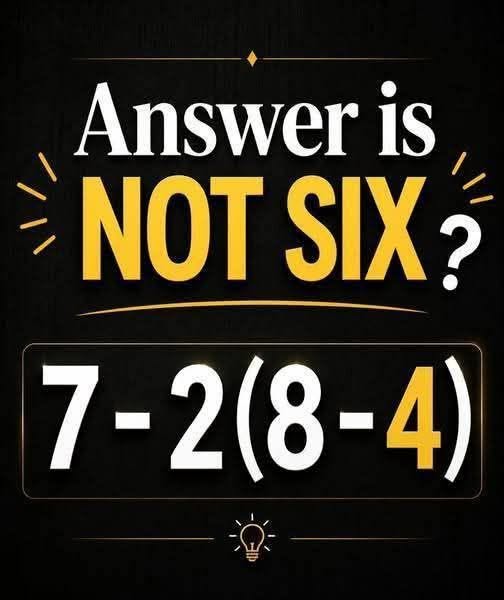
Social media is full of math puzzles designed to confuse people, spark debates, and generate thousands of comments. One of the latest viral challenges asks:
7 − 2(8 − 4) = ?
Many people quickly answer 6, while others insist the result is something completely different.
So who is right?
Let’s break it down step by step and discover why this simple-looking equation has divided the internet.
The Puzzle
The expression is:
7 − 2(8 − 4)
At first glance, some people rush through the calculation and arrive at 6, but mathematics follows a specific order of operations that must always be respected.
Step 1: Solve the Parentheses
According to the order of operations, anything inside parentheses comes first.
8 − 4 = 4
Now the equation becomes:
7 − 2(4)
Step 2: Perform the Multiplication
When a number is placed directly next to parentheses, it means multiplication.
2 × 4 = 8
The equation now becomes:
7 − 8
Step 3: Complete the Subtraction
7 − 8 = -1
Final Answer:
-1
Why Do Some People Get 6?
Many people mistakenly do the subtraction first:
7 − 2 = 5
Then:
5 × (8 − 4)
5 × 4 = 20
Or they apply operations in the wrong order and arrive at other incorrect results.
The mistake comes from ignoring the standard mathematical rules known as the Order of Operations.
Understanding PEMDAS/BODMAS
To solve expressions correctly, mathematicians use:
PEMDAS
P = Parentheses
E = Exponents
MD = Multiplication and Division
AS = Addition and Subtraction
Or in many countries: